
SAFETY · Lesson 1 of 6
Personal Safety Equipment
25 min · Beginner friendly
You’ll learn toChoose and fit a lifejacket with crotch strap, light and sprayhood · Decide when lifejackets and tethers should be worn · Clip on correctly moving around the deck
Listen mode
Listen to the complete lesson
About 11 min
The sailor most likely to drown is the one who goes into the water unexpectedly — often within sight of the boat. This lesson is about the kit that keeps that sailor alive: the on your chest and the that keeps you aboard in the first place.
Take a guess
The boom knocks you out on the way over the guardrail and you hit the water face-down. Which of these keeps your airway clear?
Commit to an answer before reading on — a wrong guess here helps the right idea stick.
Buoyancy aids and lifejackets
- Buoyancy aid
- A foam vest giving modest permanent buoyancy (around 50 Newtons). It supports a conscious swimmer but will not turn an unconscious casualty face-up.
- Lifejacket
- An inflatable (or solid) jacket with enough buoyancy, correctly distributed, to turn most unconscious wearers face-up and support the airway clear of the water.
- Newton (N)
- The unit used to buoyancy. Roughly 10 Newtons supports 1 kilogram in water; a 150N lifejacket gives about 15 kg of lift.
- Firing head
- The mechanism on an inflatable lifejacket that punctures the gas cylinder. Automatic heads fire when immersed; manual heads fire only when you pull the toggle.
| Rating | Type | Typical use |
|---|---|---|
| 50N | Dinghies, windsurfing, personal watercraft — close to help, conscious swimmer | |
| 100N | Lifejacket | Sheltered waters, light clothing; limited self-righting performance |
| 150N / 170N | Lifejacket | The standard choice for coastal and offshore cruising; turns most unconscious wearers face-up |
| 275N | Lifejacket | Offshore and heavy weather, where bulky waterproofs and boots trap air and fight the jacket |
Most cruising lifejackets inflate from a small CO2 cylinder. An automatic jacket fires within seconds of the getting wet — the best choice for most crews, because an unconscious casualty cannot pull a toggle. Every inflatable also has a manual pull toggle as a backup, and an oral inflation tube so you can top the bladder up (or inflate it entirely) by mouth. The tube also lets you deflate and repack the jacket after testing it.
Knowledge check
You are kitting out for a coastal cruise on a sailing yacht. Which is the most appropriate personal flotation choice?
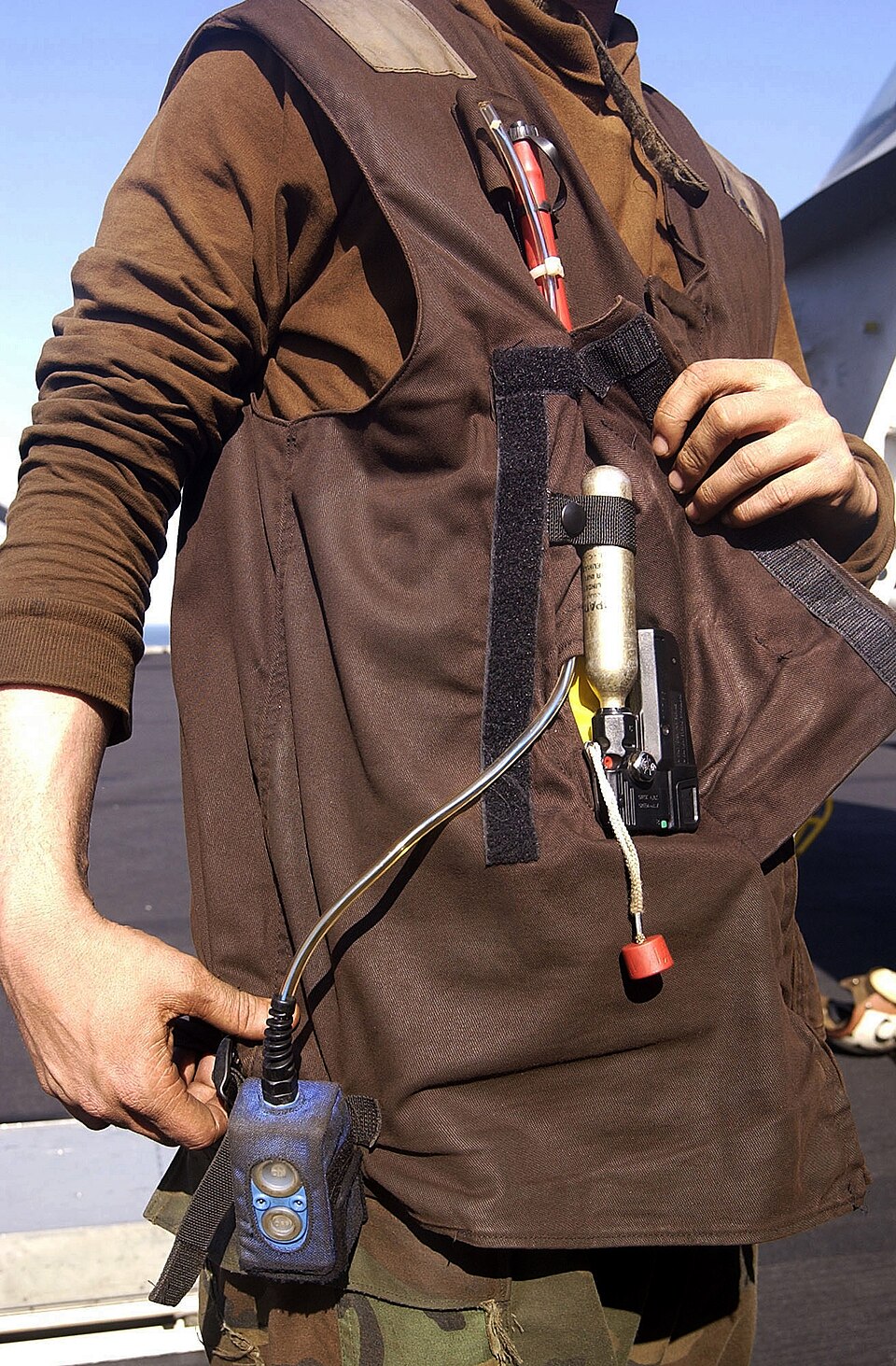
The fittings that earn their keep
- Crotch strap — passes between your legs and stops the jacket riding up over your head in the water. Without it, much of the buoyancy is wasted. Always fasten it.
- Sprayhood — a transparent hood that pulls over your face. In waves, spray drowning is a real killer; the hood keeps breaking water off your airway.
- Light — a water-activated flashing light on the shoulder. At night it is often the only thing a search crew can see.
- Whistle — carries far further than a shout, for far less effort.
- Retroreflective tape — lights up brilliantly in a searchlight or torch .
- Pocket or attachment point — many sailors add a (personal locator beacon) or beacon so the boat, or the rescue services, can find them electronically.
When to wear it
Knowledge check
Flat calm, warm evening, a 200-metre dinghy ride ashore for dinner. Lifejackets?
The legal position in most cruising areas is that lifejackets must be carried for everyone aboard; when they are worn is the skipper's decision. Good skippers publish their rules before leaving the pontoon, in a short safety briefing, so that nobody has to make a judgement call when things get busy. The simplest rule of all — worn whenever you are on deck — is never wrong.
- At night, and in or poor visibility
- In rough weather, or whenever a reef is in (if the wind is enough to reef, it is enough to knock someone over)
- When leaving the cockpit to work on deck
- In the dinghy or tender — more sailors drown on the short trip ashore than most people imagine
- Non-swimmers, children and anyone unwell or very tired: at all times on deck
- Whenever the skipper says so — and any crew member may put one on whenever they wish
Harnesses, tethers and jackstays
- Safety harness
- Strong webbing worn around the chest with a metal D-ring for attaching a tether. On most modern lifejackets the harness is built in.
- Tether (safety line)
- A strong line, usually 1–2 metres of webbing with safety hooks at each end, connecting your harness to the boat.
- Jackstay
- A webbing strap or wire running along the deck from bow to stern, to which you clip your tether so you can walk the length of the boat without unclipping.
- Strong point
- A dedicated attachment point, usually in or near the cockpit, engineered to take the shock load of a falling body.
Knowledge check
You need to go forward at night to sort a snagged headsail. Where should your tether be clipped?
The best man overboard recovery is the one that never happens, and that is what the harness system is for. A three-hook tether — one hook at the harness, and both a long (about 2 m) and a short (about 1 m) leg to the boat — lets you move hand-over-hand and stay clipped on the whole time: attach the new hook before releasing the old one. Many tethers include an overload indicator, a stitched flag that deploys if the tether has ever taken a shock load, telling you to retire it.
- Clip on before you leave the cockpit, not after you reach the foredeck.
- Work on the side and clip to the windward where possible — if you slip, you fall into the boat, not over the side.
- Use the short leg near the rail: the aim is to stay on the boat, not to be towed beside it.
- Clip to , padeyes and dedicated strong points — never to guardwires, stanchions or running rigging, which are not built for shock loads.
- At night and in rough weather, clip on even in the cockpit — most crews are lost from the cockpit, not the foredeck.
Care and servicing
An inflatable lifejacket is a machine, and machines need maintenance. At least once a season — and after any inflation — open the jacket up, inflate it by mouth and leave it overnight to check it holds pressure. Weigh the CO2 cylinder against the figure stamped on it, check the firing mechanism is in date and correctly armed, and look for chafe on the bladder and webbing. Rinse salt off, dry thoroughly, and repack following the manufacturer's fold. A jacket that lives at the bottom of a wet locker, unopened for five years, is a decoration, not a lifejacket.
Your turn
A new crew member arrives on your boat having never worn a lifejacket. In five short steps, describe how you would brief them to fit and check their jacket before you slip lines.
Work it through on paper first — then check yourself against the solution. Reading a worked answer feels like learning; producing one is learning.
Key points
- A lifejacket (150N or more for cruising) turns an unconscious casualty face-up; a 50N buoyancy aid cannot.
- Automatic inflation, a crotch strap, sprayhood, light and whistle turn a basic jacket into survival equipment.
- Fit snug over your sailing clothes: two-finger waist check, crotch strap always fastened.
- Wear it at night, in fog, in rough weather, on deck, in the dinghy — and whenever the skipper says.
- Clip on before leaving the cockpit, to windward, to jackstays and strong points — never to guardwires.
- Service the jacket yearly: inflate overnight, weigh the cylinder, check the firing head, repack dry.
Finished this lesson?
Working through the sections marks it complete — or mark it yourself.